
How You Actually Get Paid If Hit by an Uninsured or Underinsured Driver in California

In this article
Here is a scenario that plays out constantly: the crash clearly was not your fault, your injuries are real, and the person who caused all of it either has no policy or a policy that will not come close to covering the damage. Nationally, industry research puts the uninsured-driver rate at roughly one in seven, with wide variation between states — and a large share of insured drivers carry only the bare state minimum.
If you have been hit by an uninsured driver, the case does not end there. It changes shape, because the insurance company that ends up paying is usually your own. This is general information, not legal advice.
The short answer
If you carry uninsured/underinsured motorist coverage, it steps in to pay what the at-fault driver cannot — medical bills, lost income, and pain and suffering, up to your UM/UIM limits. An uninsured motorist claim in California is, in effect, a claim against your own insurer standing in the at-fault driver's shoes.
But here is the part that catches people: the deadlines do not come from the familiar two-year personal injury statute. They come from your policy and from Insurance Code section 11580.2, and they are often far shorter.
UM vs. UIM: what is the difference?
The two coverages sit on the same line of your policy, but they work differently — and the difference decides how much money is actually available.
| Uninsured motorist (UM) | Underinsured motorist (UIM) | |
|---|---|---|
| When it applies | The at-fault driver has no insurance, or fled and was never identified | The at-fault driver has insurance, but their limits are lower than your UIM limits — and lower than your damages |
| Who pays | Your own insurer | Your own insurer, after the at-fault driver's policy pays out in full |
| Key condition | Uninsured status, or the hit-and-run rules below | You must first exhaust the at-fault driver's policy limits |
| The catch | The two-year preservation rule | The offset — what the other insurer paid comes off your limit |
UM is the cleaner case: the other driver has nothing, so your insurer pays your damages up to your UM limits. It also covers you as a pedestrian or cyclist struck by an uninsured car — the coverage follows you, not your vehicle.
UIM is the two-step version: first you collect the at-fault driver's full policy limits, then your own UIM coverage addresses the shortfall. One threshold rule surprises everyone — UIM only helps if your UIM limits are higher than the at-fault driver's liability limits. Match them exactly and UIM pays nothing.
How the UIM offset works — with real numbers
California UIM is an offset system, not a stacking system. Your UIM limit is reduced, dollar for dollar, by what the at-fault driver's insurer paid:
| The math | |
|---|---|
| Your UIM limit | $100,000 |
| Paid by the at-fault driver's insurer | − $30,000 |
| Maximum available from your UIM coverage | $70,000 |
Not $100,000 on top of the $30,000 — $70,000 from your own carrier, for a combined ceiling of $100,000. Run the same math with 30/60 UIM against a 30/60 at-fault policy and you get the equal-limits trap: $30,000 − $30,000 = $0.
This is the single best argument for carrying UIM limits well above the state minimum — and almost nobody explains it until after a crash, when it is too late to change.

Do you even have this coverage?
Pull your declarations page — the summary sheet at the front of your policy — and look for a line reading "Uninsured Motorist Bodily Injury" or "UM/UIM," followed by two numbers like 100/300. That is your per-person and per-accident protection.
Most drivers have it, because section 11580.2 provides that the coverage is included unless the insurer and the named insured delete it by written agreement. If you never signed a waiver, you very likely have the coverage. If someone in your household waived it years ago to shave a few dollars off the premium, that signature is worth revisiting — particularly now that California's minimum liability limits sit at 30/60/15, an amount a single surgery can outrun.
Separately, some policies carry uninsured motorist property damage. Under Insurance Code section 11580.26 that coverage pays the lesser of actual cash value or $3,500, requires actual direct physical contact, requires that the uninsured owner, operator, or vehicle be identified, and must be reported to your insurer within 10 business days. It is a narrow benefit, and it does not cover a hit-and-run by an unidentified driver.
Hit-and-run and phantom vehicles: special rules, shorter deadlines
When the driver who hit you disappears, California treats the unknown driver as uninsured, which makes your UM coverage the path to recovery. But a hit-and-run UM claim carries three statutory conditions under section 11580.2(b), and they are enforced literally.
1. Physical contact
The statute requires that the bodily injury "arisen out of physical contact of the automobile with the insured or with an automobile that the insured is occupying." A pure "phantom" driver who runs you off the road without touching anything generally does not qualify, no matter how many witnesses saw it.
2. A police report within 24 hours
The accident must be reported within 24 hours to the police. This is a bright line, not a guideline. Call it in from the scene and get the report number — our accident report guide covers how to obtain the copy afterward.
3. A sworn statement within 30 days
You must file with the insurer, within 30 days, a statement under oath that you were injured and setting out the supporting facts. A phone call to the claims line does not satisfy this — it has to be in writing, sworn, and on time.
Miss any of the three and the claim can fail before anyone argues about fault or damages.
The deadline that quietly kills UM claims
This one deserves its own heading. Section 11580.2(i) provides that no cause of action accrues under a UM policy unless, within two years of the accident, one of three things has happened:
- A suit for bodily injury has been filed against the uninsured motorist;
- An agreement as to the amount due under the policy has been concluded; or
- The insured has formally instituted arbitration proceedings.
Simply having a claim open and trading phone calls with an adjuster does not stop that clock. It is a trap that has quietly ended legitimate claims — the file feels active right up until the day it is worthless.
Filing the claim: your own insurer is now the opposing party
This is the mindset shift that decides these cases. You have paid premiums for years and the adjuster is pleasant, so it feels like the company is on your side. Structurally, it is not: every dollar your UM claim is worth is a dollar your insurer pays. The same tactics used against third-party claimants — minimizing injuries, blaming preexisting conditions, lowball anchoring — appear here too, in a warmer tone.
Two things make this trickier than an ordinary claim. First, you owe your own insurer duties you do not owe the other side: cooperation, documentation, and sometimes a recorded statement or examination under oath, plus a medical examination. You cannot simply refuse the way you might with the at-fault carrier's adjuster — but you can prepare, and you are entitled to have counsel involved. Our guide to dealing with insurance adjusters covers the conversational traps.
Second, if the insurer will not pay fairly, UM/UIM disputes generally do not go to a jury — they go to binding arbitration under the policy, typically before a neutral arbitrator who decides both fault and damages. Arbitration is faster than trial and very winnable with good preparation, but it is a formal proceeding with evidence, experts, and cross-examination. It is not a phone negotiation with extra steps.
Your insurer also owes you a duty of good faith, and an unreasonably denied or slow-walked UM claim can create exposure beyond the policy itself.
Proposition 213: the rule nobody warns uninsured drivers about
Under Civil Code section 3333.4 — enacted by Proposition 213 in 1996 — a person who owned an uninsured vehicle involved in the accident, or who cannot establish financial responsibility, generally cannot recover non-economic damages, even if the crash was entirely the other driver's fault.
It is as harsh as it sounds. An uninsured driver rear-ended at a red light by a texting motorist can still recover economic damages — medical bills, lost wages, vehicle damage. But the non-economic damages that often make up the largest share of a serious injury claim are off the table. In a major-injury case, Prop 213 can erase most of the claim's value in one stroke.
The exceptions are narrow but real. Subdivision (c) provides that an uninsured owner injured by a driver who violates the DUI statutes is not barred from recovering non-economic damages. And because the statute's bars run to owners and operators, passengers generally fall outside them. Details matter enormously at the margins — whose car it was, who was insured under which policy, and exactly when coverage lapsed can each change the outcome. "I was uninsured, so I have no case" is the wrong conclusion to reach on your own.
Will your rates go up if you file?
The fear that stops people from using coverage they paid for deserves a straight answer. Insurance Code section 491 provides that a motor vehicle liability insurer's rating plan "shall not provide for an increase in the premium if based upon an accident in which the insured is not at fault." The statute also requires an insurer to investigate before concluding you were at fault contrary to an accident report.
Insurers do raise rates across whole classes of customers at renewal for reasons unrelated to your claim, and disputes over the "not at fault" determination occasionally arise. But declining to file a five- or six-figure UM claim to avoid a surcharge the law forbids is a trade no one should make.
Can you sue the uninsured driver directly?
Yes — and sometimes you must, since filing suit is one of the three ways to preserve the UM claim inside the two-year window. But go in clear-eyed about collection. A judgment against a driver with no insurance and no assets is often just a piece of paper.
It is not always worthless. California can suspend the license of a driver who leaves an injury judgment unpaid, which creates real pressure toward a payment plan, and a defendant with steady income or property can be pursued through wage garnishment and liens. In practice the UM claim is the reliable recovery and the direct suit is the pressure valve — an experienced attorney runs both tracks in parallel rather than choosing one.
The bottom line
When an uninsured or underinsured driver hurts you, the claim that pays is usually the one against your own policy — governed by shorter deadlines, an offset that shrinks the available money, and an insurer that is now, politely, your adversary.
Three numbers to remember: 24 hours for the hit-and-run police report, 30 days for the sworn statement, two years to sue, settle, or demand arbitration. And one decision to make long before any of it matters: carry UM/UIM limits high enough that the offset math still protects you.
If your crash happened locally, our Folsom car accident guide walks through the agencies, hospitals, and deadlines involved. Mason Law, P.C. handles uninsured and underinsured motorist claims throughout Folsom and the Sacramento region — including the sworn statements, exhaustion letters, and UM arbitrations that decide these cases. We will read your policy, run the offset math, calendar every deadline, and deal with your insurer. Start with a free case evaluation — you pay nothing unless we recover for you, and every case turns on its own facts. Our California car accident attorneys can be reached at (916) 587-2997. Not sure what to do first? Start with what to do after a car accident in California.
Frequently Asked Questions
What if the driver who hit me has no insurance?
Does UM coverage pay for pain and suffering?
Will filing a UM claim raise my rates?
What is Proposition 213?
How long do I have to file a UM claim in California?
Do I need a police report for a hit-and-run claim?
What is the UIM offset in California?
Have a question about your situation?
Our California personal injury attorneys offer free, confidential consultations.
Keep Reading
Related Articles

Who Pays Your Medical Bills After a California Car Accident?
The at-fault driver's insurer does not pay your bills as they arrive — it pays once, at the end. Here is what carries you in the meantime, what gets repaid from the settlement, and the legal caps that limit those repayments.
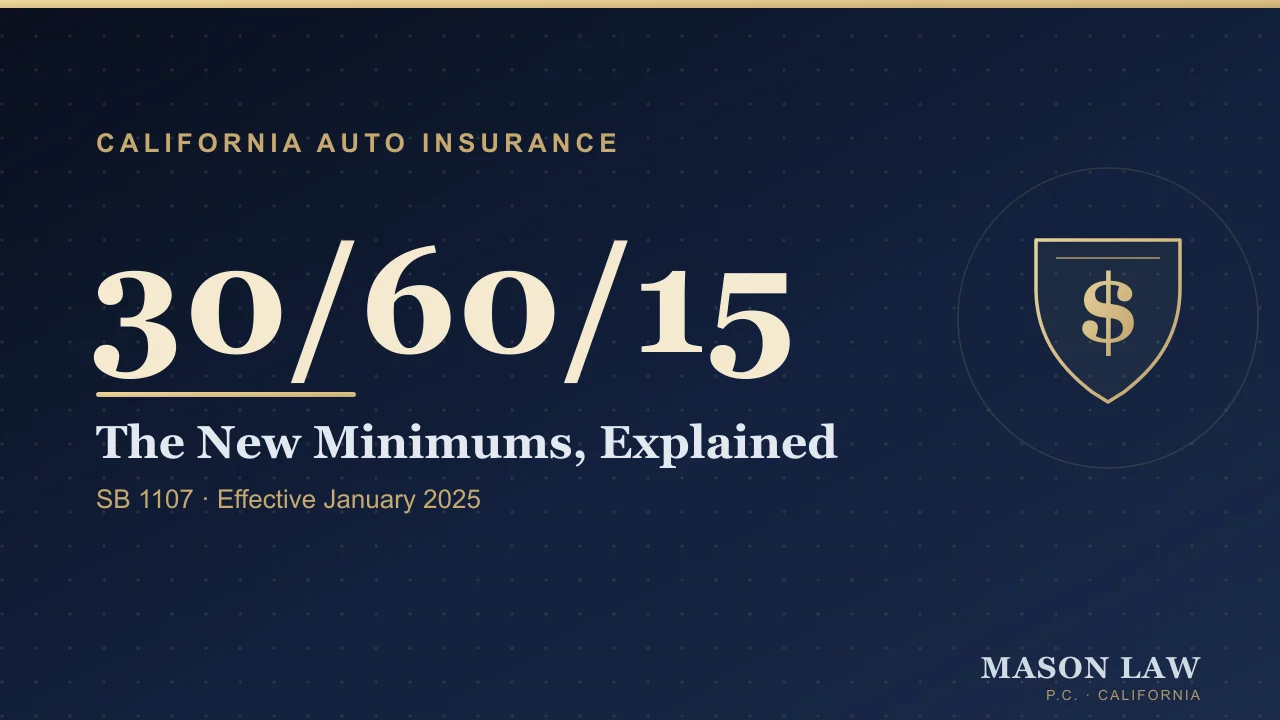
California's New 30/60/15 Insurance Minimums, Explained
California raised its minimum auto insurance to 30/60/15 in 2025 under SB 1107. Here is what the new numbers mean, why they still fall short in a serious injury, and how it affects your claim.
Dealing With Insurance Adjusters After a California Accident
The adjuster is friendly, but they work for the insurer. Here is what California law requires of them, what a recorded statement is really for, and how to handle the first offer without damaging your claim.
Uber and Lyft Accidents in California: Whose Insurance Pays?
In a California rideshare crash, which policy pays depends on exactly what the driver was doing at that moment. Here are the three coverage periods set by state law, and the dollar figures attached to each.

What Damages Are Available in a Wrongful Death Case?
Wrongful death damages in California cover both financial losses and the harder-to-measure loss of a loved one. Here is what may be recoverable.
Wrongful Death vs. Survival Actions in California
These two claims often arise from the same death but compensate different losses. Here is how they differ in California.